


Introduction
When you want to sell products to countries, one of the hardest things is not finding people to buy from you it is figuring out how much to charge for your product. If you charge little you will not make as much money as you want or you might even lose money because of extra costs that you did not think about. If you charge much someone else will sell it to the buyer instead of you.
The good thing is that figuring out how much to charge for your product when you sell it to countries is not just a guess. There is a way to do it once you know about all the costs involved. In this guide we will show you how people who sell products to other countries calculate their prices step by step so you can be sure that you are charging the right amount to your buyers.
We will use an example. Selling Himalayan pink salt from Pakistan. To show you every step of the way from how much the salt costs to begin with to how much you should charge the buyer.
The Four Categories of Export Costs
Before you can tell someone how much your product costs you need to know that there are four types of costs when you sell products to other countries. If you forget about any of these your calculations will be wrong. You will not make as much money as you could.
- There are costs for the product itself and its packaging, which we call product-side expenses.
- There are costs for moving the product around which we call transport-side expenses.
- There are costs for getting the product through customs, which we call clearing and customs expenses.
- There are costs, for running your business and getting the product to the buyer, which we call factory and overhead expenses.
Lets talk about each of these export costs in detail.
1. Product Side Expenses
When we talk about product-side expenses we are talking about two things: the cost of the raw product and the cost of packaging.
Product Price
The price of every product is different. This is because products are traded in ways. Sometimes by the ton sometimes by the kilogram and sometimes by the piece. For example Himalayan pink salt, which comes in F10 lumps is traded by the ton. So if the price of pink salt is 16,000 in local currency per ton and you put 28 tons of Himalayan pink salt in one container the cost of the raw Himalayan pink salt for that container will be around 448,000.
The main thing to remember here is that you need to know how your product like pink salt is measured. Is it by the ton by the kilogram or by the piece? You need to know this before you start doing any calculations. If you use the unit of measurement for your product like Himalayan pink salt all of your numbers will be wrong.
Packaging Cost
The packaging cost includes everything that is needed to get the product like pink salt, ready to be shipped. This includes the bags, cartons or boxes and the labor cost to pack the product into them. For the pink salt example this included the cost of jumbo bags and the labor cost to fill the jumbo bags with Himalayan pink salt, which was around 45,000 for the container.
When you add the cost of the product like pink salt and the packaging cost together you get the total product-side cost. For the pink salt example this is around 493,000. This is the basis for calculating the export price of the product, like pink salt.
2. Transport Side Expenses
The cost of transport is what you pay to move a container from the shipping terminal to your factory or warehouse. Then you have to pay to take the loaded container to the terminal.
This includes:
- Container pickup and drop-off. This means bringing a container from the terminal to your location and then taking it back
- Transport cost. This can be very different depending on how far your location is from the port. If the container is coming from away it will cost a lot more than if it is coming from a nearby area
- Container loading cost. This is what you pay for the labor to load the product into the container
One thing that new exporters often forget is to add the cost of loading the container to their expenses. This is separate from the cost of transport. If you do not do this it can reduce your profit margins.
3. Clearing and Customs Expenses
When your container crosses a border you have to pay customs and clearing charges. These expenses usually include:
- Customs clearing agents fee. This is what you pay to the agent who helps you with customs clearance
- Terminal wharfage fee. This is a charge from the container terminal. It can be a part of your total clearing cost
- Documentation costs. These are the costs for the Bill of Lading and any other paperwork you need. If you have a product you might not need a lot of paperwork
When you add all these expenses together you get your total clearing cost. For example it could be around 91,000. Remember that clearing costs can be different depending on the product the port and the current customs rates. So always check the figures with your clearing agent. Do not use numbers. Transport costs and clearing costs like these are Transport-Side Expenses and Clearing and Customs Expenses, for your container.
4. Overhead Charges
Now we need to think about the cost of shipping things from one country to another. This is where the cost of moving your container by sea or air comes in. You have to pay to get your container from your port to the buyers port.
There are a few things to consider:
- Freight charge. This is usually given to you in US dollars by the company that helps you with shipping, like $800 in our example
- Exchange rate conversion. You need to know the current exchange rate so you can convert the US dollars into your own money to figure out your total cost
- Charges. These are fees like the Bill of Lading charge, seal charge and other things that the shipping company charges you locally separate from the cost of shipping
One thing to keep in mind: shipping companies and customs agents can help you with this but you are responsible for making sure you have the right rates and terms. Always get the costs of shipping and local charges in writing before you finalize your price.
Putting It Together The Total Cost Calculation
Once you have all the numbers for the costs you add them up to get the total cost of one container. This total cost is what you use to figure out your price per ton per kilogram or per piece. Whatever the buyer wants. You use this cost as the base number in your price calculation to determine your final quoted price, for the buyer. The total cost of Freight and Overhead Charges and other costs all add up to this number.
Understanding FOB, CNF and CIF Pricing
A lot of exporters get confused about these terms so let us explain them in simple terms. When you give a buyer a quote you usually give them three prices to consider:
Price A: FOB, which means Free on Board
The exporter pays for everything up to the point where the goods are loaded onto the ship at the port where they start their journey. The buyer then. Pays for the rest of the shipping costs themselves. However the exporter still pays for some costs at the starting port like paperwork fees and security fees.
Price B: CNF, which is also known as Cost and Freight
The exporter pays for everything, including shipping, all the way to the port where the buyer is located. The buyer does not have to pay extra for shipping because it is already included in the price the exporter gave them.
Price C: CIF, which means Cost, Insurance and Freight
This is similar to CNF. The exporter also pays for insurance to protect the goods during shipping. This gives the buyer protection and is often what first-time buyers or buyers from other countries prefer.
For all three types of prices the exporter adds their profit and any extra fees like bank fees on top of the basic cost of the goods. Exporters often add a profit margin of, around 50%. This can be adjusted depending on the market and who else is selling similar goods.
Don’t Forget Bank Charges
One cost that is easy to miss is bank charges. When you get money from another country your bank takes a percentage as a fee for handling the transaction. About 1.3 to 1.5 percent but this can be more depending on the rules of the bank right now (sometimes, up to 2.5 percent including taxes). Make sure to include this in your price because it really reduces the amount you get not just a simple paper work step.
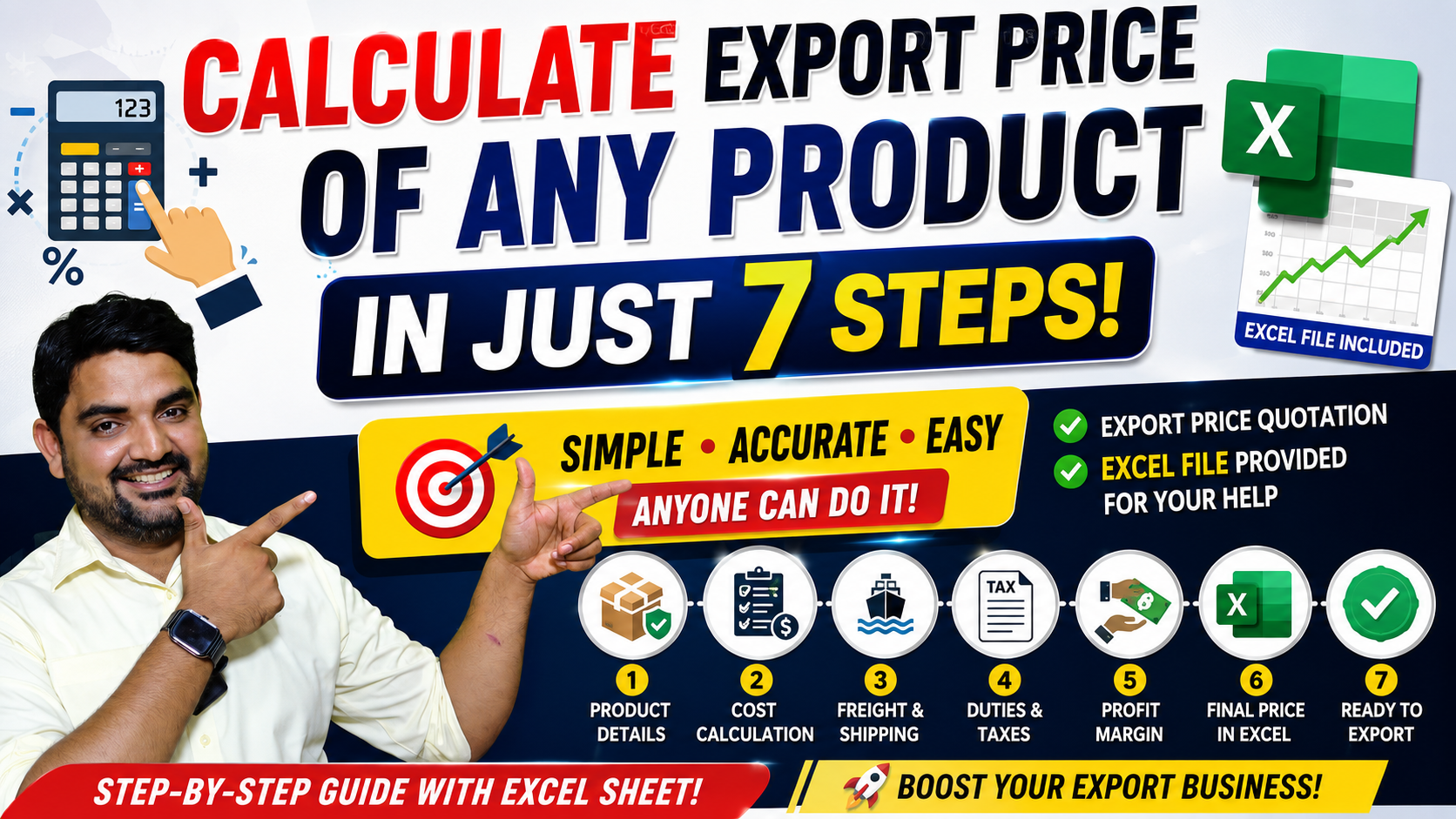
How to Calculate Your Export Price
- Find out what your product is sold in (ton, kg or piece). Figure out the cost of the raw product
- Include the cost of packaging (materials and labor)
- Include the cost of moving the product locally (pickup, delivery and labor to load the container)
- Include the cost of getting the product through customs (agent fee, terminal wharfage and paperwork)
- Convert the freight cost using the current exchange rate and add local freight-forwarder charges
- Add all these costs together to get your landed cost per container
- Divide that total by the number of items you have to get a base cost per unit
- Add the profit margin you want
- Add the insurance cost (only for CIF quotes)
- Add bank charges to cover deductions from international payments
- Show your final price, as FOB, CNF or CIF depending on what the buyer wants
Frequently Asked Questions
FOB means the buyer pays freight from the port of origin; CNF means the exporter pays freight all the way to the destination port; CIF is the same as CNF but with insurance included, paid by the exporter.
Container loading labor costs and bank charges on international payments are two of the most frequently overlooked expenses.
Freight forwarders and customs clearing agents can be found through industry referrals, trade associations, or your local Chamber of Commerce. Always deal with them directly and confirm rates in writing.
Not necessarily. While a common starting point is around 50%, your margin should reflect market conditions, competition, and the buyer relationship. The key is knowing your full landed cost first, so any margin you set is based on real numbers.
Final Thoughts
Figuring out a price to sell something overseas is not that hard when you think about it. You just need to consider an important things: how much the product costs, getting it from one place to another clearing it and other costs like freight. The people who do selling things to other countries are not always the ones, with the cheapest stuff. They are the ones who get the price right think about all the costs and make sure they still make a profit.
Using a worksheet with different parts for calculating the total cost and the price you will charge makes it easy to do this every time you sell something new or send a shipment. This way you will never be surprised by a cost you forgot about. You can use this worksheet for every product or shipment and it will help you to always get the price right and make a good profit.

