


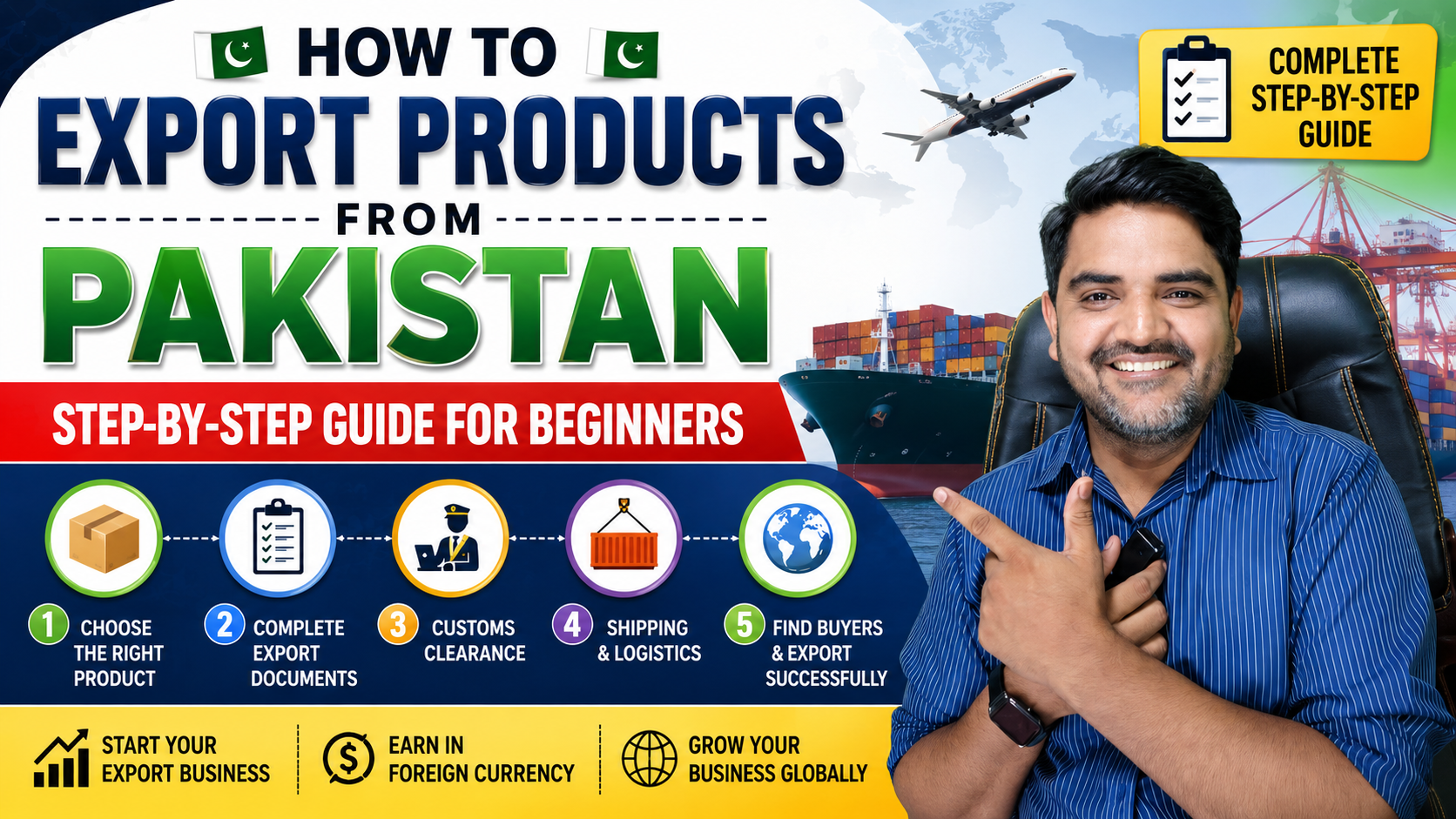
Exporting from Pakistan can feel really tough if you are new to it.. If you take it one step at a time it becomes quite easy. If you are a business owner or someone who wants to sell products abroad this guide will help you understand how to export products from Pakistan. We will walk you through the process from deciding to export to getting paid.
We have broken down the export process into four steps:
- Preparation for Export
- Getting Ready for Export (Marketing & Buyers)
- Documentation & Customs Clearance
- Shipment & Payment
Now lets look at each step, in detail.
Step 1 : Getting Ready to Export
Before you send one box to another country you need to have things in order. This step is about making sure your business and your product are ready to sell in countries.
1. Picking the Right Product
The important thing to do when you want to export is to choose a good product. A good product to export is one that
- has a lot of buyers in countries
- does not have too many other people selling it
- can make you a good profit
- is easy to find in Pakistan
Some things that people in Pakistan export a lot are spices like sesame seeds and the ingredients for garam masala, clothes, rice, leather things and medical tools. If you do your research before you decide on a product you will not waste time or money. Get frustrated later. Export business is, about the product you choose so you need to choose the right product for your export business.
2. Business Registration
You need to have a business that is registered to do things like export or import. In Pakistan people usually start one of three kinds of businesses.
| Business Type | Description | Best For |
|---|---|---|
|
Sole Proprietorship |
Owned and run by one person |
Beginners, low-cost setup |
|
Partnership |
Two or more partners running the business together |
Shared investment/expertise |
|
Private Limited Company (Pvt Ltd / SMC) |
Requires at least one director (SMC) or two directors (Pvt Ltd) |
Larger, scalable operations |
For new exporters a sole proprietorship is the easiest way to start because it has fewer legal formalities and is less costly.
3. Essential Registrations You’ll Need
To export from Pakistan you need to complete these registrations:
- NTN with the FBR
- Sales Tax Registration
- Chamber of Commerce Membership
- PSW Registration
These registrations are necessary to import or export goods officially.
4. Build a Professional Online Presence
In todays trade world having a professional website is a must. International buyers usually search for your company online before working with you. If they find nothing or an unprofessional page it hurts your chances.
Make sure you have:
- A good business website that shows your products
- A custom. A professional business email
- Active social media profiles, on platforms
Your website is often the first thing buyers see so spend money on getting it done right by a skilled web professional.
Step 2 : Getting Ready to Export Marketing, Buyers & Pricing
Now that your business is set up and online it’s time to find buyers.
Finding International Buyers
Social media, B2B platforms and trade directories can help you connect with buyers from countries.
You need to keep reaching out and stay buyers must be able to find you know about your product and trust your business before they buy.
Calculating Your Export Price
Pricing your product right is crucial for making a profit. When calculating your export price you should consider:
- Product cost
- Packaging
- Local transportation
- Freight charges
- Customs and clearing costs
- Your profit margin
Using a pricing worksheet can help you get it right. Many exporters use an Excel calculator to make sure they don’t underprice or overprice their goods.
The Proforma Invoice
When a buyer agrees to your price they will ask for a Proforma Invoice. This is an invoice that shows estimated quantity, weight and value before the shipment is finalized.
The Proforma Invoice is needed whether the buyer pays with a Letter of Credit or advance payment.
Key Details, in a Proforma Invoice
- Exporters. Details
- Buyers. Details
- Quantity and weight
- Total value
When the actual shipment is finalized the Proforma Invoice becomes a Final Invoice.
Step 3 : Documentation and Customs Clearance
This is where the technical side of exporting gets tricky. You need two pros on your team:
- Customs Clearing Agent – they handle getting your goods through customs no matter if they’re coming by sea or air.
- Freight Forwarder – they take care of logistics with shipping lines and airlines arrange rates. Give you the Bill of Lading.
Getting the Foreign Inward Remittance Certificate
Once your bank confirms payment or a Letter of Credit you need to get a Foreign Inward Advice issued. Your bank will give you a form to fill out with your company details and what you’re shipping. After you submit it they generate the FIA. You can start prepping your shipment.
Booking Your Shipment
To book a container or air cargo space reach out to freight forwarders – ideally 4 or 5. Give them:
- The type of equipment you need (like a 20ft or 40ft container or air cargo by KG).
- The destination port.
- Details, about your product.
After comparing rates you’ll get a Booking Confirmation. This includes container details, where to pick up the container and terminal info.
The Customs Clearance Process
Now your clearing agent takes over:
- They pick up the container and get it loaded.
- Once its loaded they handle customs clearance, inspections and payments at the terminal.
- They make sure the container is cleared and gets loaded onto the ship or plane.
Step 4 : Shipment and Payment
Getting the Bill of Lading
After the shipment leaves your freight forwarder gets the Bill of Lading. This paper proves that your goods have been shipped. To get the Bill of Lading you usually need to give them:
- A copy of the Goods Declaration
- Bank papers, like NOC certificate and CNF certificate
Preparing Export Papers
You also need to prepare these papers:
- Commercial Invoice
- Packing List
- Certificate of Origin. Your clearing agent will issue this
- Phytosanitary Certificate. Only if you’re shipping plants, wood or food
Getting Paid
- If you need advance payment you send shipping papers to the buyer.
- If you use a Letter of Credit you give papers to your bank. They send them to the buyers bank to check.
The buyers bank checks the papers. If they are okay you get paid in 10 to 12 days.
That’s it. Your export shipment is done!
Final Thoughts
Exporting from Pakistan is pretty simple when you know how it works. You just need to follow four steps: get ready find buyers and market your stuff deal with papers and customs and then ship your products and get paid. Each step is, like a building block so you need to do them in order. If you have all the papers, a good website and people who can help you like a customs agent and a shipping company you can have a business that exports things and makes money for a long time.
When you are just starting out think about what products you want to sell and make sure your business is registered properly. Everything else will fall into place after that. Exporting from Pakistan and finding buyers and marketing your products will be a lot easier when you have a foundation.

