
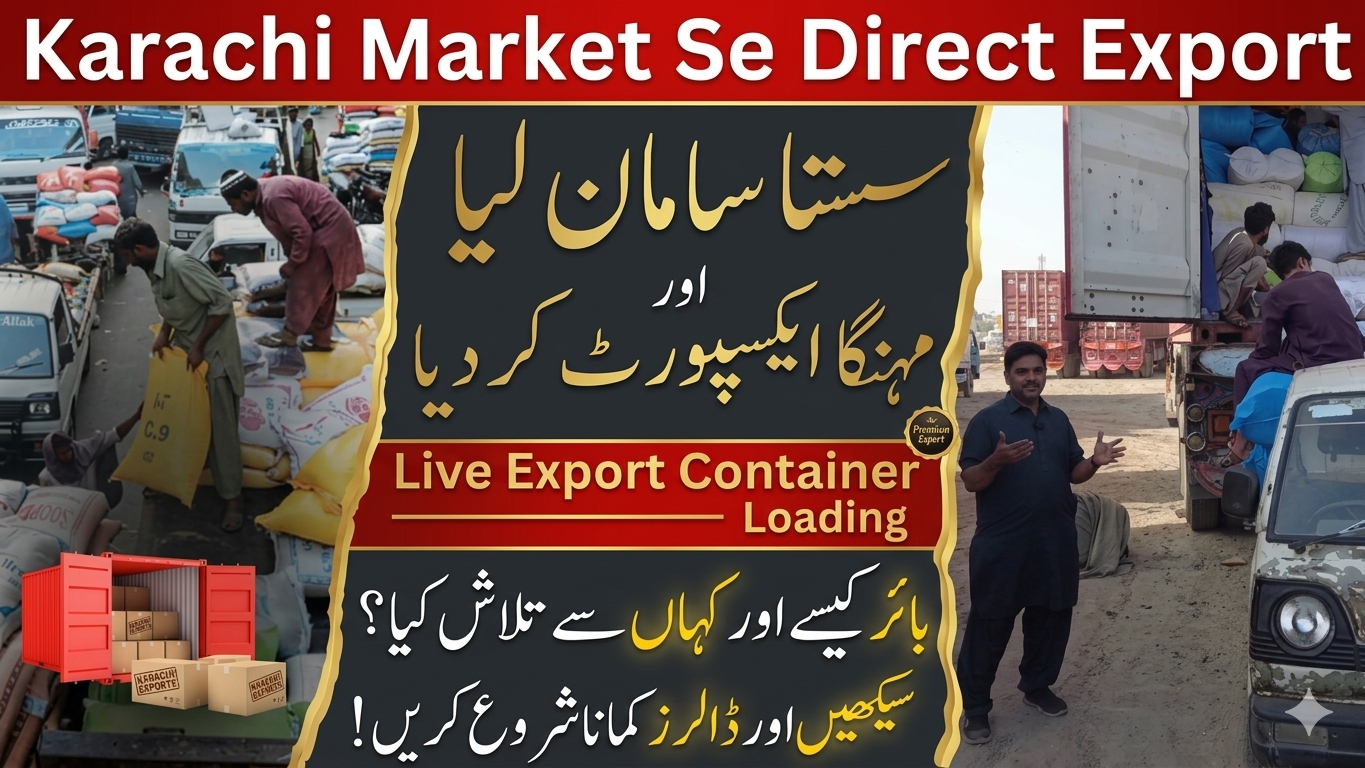
A step-by-step breakdown of how Pakistani exporters source products locally from Karachi markets, load full containers, and profitably export to international buyers — with insider tips on finding buyers and building a strong online presence.

Table of Contents
01 What is Direct Export from Karachi Markets?
02 Live Container Loading Process — Step by Step
03 Products Exported: Cotton Rope, PP Plates & More
04 The Power of Sending Samples with Bulk Orders
05 Key Challenges in Field Loading & How to Overcome Them
06 How to Find International Buyers — 2 Proven Methods
07 Building Your Online Presence for Export Success
08 Why Your Export Website is Your #1 Sales Tool
09 B2B Platforms and Paid Advertising for Exporters
10 FAQs About Exporting from Karachi
Sourcing products from Karachi’s local markets and exporting them internationally is a highly profitable model — if you know how to find buyers, how to optimize your container loading, and how to maintain a professional digital presence. This guide breaks it all down with real, field-tested experience.
What is Direct Export from Karachi Markets?
When an exporter desires to buy raw materials and finished products in Karachi, they typically buy them locally (at a lower cost than purchasing abroad), then ship the goods to their overseas clients (for a much greater price than they had incurred while producing the goods in Pakistan). This method of export is commonly known as sasta saman liya aur mehanga export kar diya (meaning, “buying things that are inexpensive; exporting them for a lot more”). This particular type of exporting is the simplest way to become an exporter out of Pakistan.
Exporters conduct business out of Karachi and benefit from two key advantages due to its status as the Commercial Capital of Pakistan and the primary Sea Port of Pakistan. First, because Karachi is the Commercial Capital, it allows exporters to find products locally and ship them directly from the port to the rest of the world without the delays associated with transporting products from other Pakistan cities such as Lahore and Faisalabad. Second, in times of bad weather or seasonal slowdowns, Karachi can serve as an alternate source for Pakistan exporters when severe weather affects manufacturers in the Punjab region.
On this particular export shipment, the exporter originally intended to source all raw goods from the Punjab region; however, due to the excessive rainfall that affected manufacturers and damaged materials throughout the Punjab region, the exporter was required to have the raw materials manufactured locally in Karachi. This last minute pivot in this exporter’s plan demonstrates the amount of creativity that successful exporters use to find solutions when exporting goods/products.
Container Loading Process in Real Life Step-by-Step Check list
A good understanding of how to load containers in a practical setting (not just a theoretical one) will provide any new exporters with a superb advantage over others working within the same export industry. Here is the comprehensive account of an actual loading operation completed in Karachi.
Step 1 Gather Pre-Loaded Cargo from Punjab
This particular shipment started with approximately 80% of the cargo already inside the container prior to the arrival of the truck delivering the pre-loaded cargo and the actual shipping containers. The portion of the loaded cargo that was shipped from Punjab includes parts known as “Shirki” that are used in textile and garment manufacturing, specifically for the operation of sewing machines. All of the materials were pre-packed, pre-sealed, and then sent from Punjab to Karachi via truck. Using preloaded cargo from where it is manufactured is a very effective strategy used by exporters working from multiple locations to complete their containers via loading them in Karachi.
Step 2 Coordinate Additional Karachi Cargo
The remaining portion of the loaded cargo (cotton rope and polypropylene plates) was sourced from and manufactured in Karachi. The two loads of additional cargo were delivered the same day and in two separate delivery vehicles (Suzuki pick-up trucks). Coordination is very important in this situation as vessels have strict schedules, and any delays in loading can be very costly to the exporter. This is why the exporter was present at the loading site, to ensure that everything would be loaded onto the vessel at the same time.
Step 3 Loading a Field Without A Warehouse
Rather than transfer the container to a warehouse for loading (which would have taken additional time after 11 pm), direct loading was performed from the street. Although logistically difficult – especially because there was no ramp available and the bundles were very heavy – it allowed the shipment to meet the vessel’s schedule. Workers manually lifted, stacked, and loaded heavy sacks without using any mechanical assistance; however, this was a difficult reality, but was necessary for time-sensitive shipments.
Step 4 Maximizing Container Space
Zero wasted space is one of the primary principles used when loading a container. If a foreign customer receives their container with empty pockets, this is an indication of poor planning, which ultimately may damage that customer’s trust. All voids in the container were filled and the loading also took into account both the bulk orders and the sample orders that were included with the bulk orders to achieve a tightly loaded, fully maximized, 40-foot container.
Step 5 Seal and Move to Port
Once the container was completely loaded, it was sealed. Because the load from Karachi is secured prior to transportation from the point of sourcing, the load was already secured at the field loading site. After the final pieces were loaded, the transportation vehicle moved the container directly to the port for connection with the vessel.
Export Products Cotton Rope, PP Plates & Shirki
This container contained three different types of products, showcasing the many areas within the Pakistani export economy.
1. Shirki (Textile Machine Cutting Parts)
Shirki are specialized cutting accessories used in sewing machines, such as industrial sewing machines manufactured by Singer. They are made in Punjab and represent a small but growing export market in those countries that manufacture garments. Pakistan has a strong comparative advantage in textile machinery parts, so Shirki fits easily into the export market.
2. PP (Polypropylene) Plates
This shipment included two sizes of PP plates, the largest and medium. The PP plate has a wide range of uses in industrial and packaging applications, and Pakistan has a competitive manufacturing base for producing PP plates. The order was for two sizes of PP plates (autofill standard sizes are 5 or 6), which is standard for custom-made bulk orders from buyers who have specific requirements.
3). Cotton Rope
The cargo of cotton rope was the principal item for this shipment. The cotton rope had previously been sampled and received by the buyer, and this subsequent bulk shipment was a direct result of its approval. The ideal export journey consists of the sequence of events (sample → approval → bulk order). The cotton rope was loaded into vegetable-type sacks and carefully stacked into the container. In addition, polyester rope coils were included as samples for future orders of that type to entice potential customers for that additional product range.
The Effectiveness of Sending Other Product Samples with Your Bulk Shipments
One of the most important things that were discussed in this live export was the practice of ALWAYS shipping samples of other products with bulk orders. This is a low-cost/high-return way to expand your export product offering and increase per customer relationship revenue.
When you send out 100 unique product samples to buyers around the world, you can expect to receive an order back from about 40 of those, giving you a 40% chance of converting a cold outreach attempt into an actual sale. Sample sending is, thus, one of the highest ROI activities an exporter can perform.
The following tips will clarify how to maximize your sample sending efforts
01 Utilize all available empty shipping space to send new/relevant product samples. Since most products are shipped by freight, there is no real cost to shipping the additional samples, other than the actual products.
02 Clearly label the package as containing samples for buyer evaluation, and not as part of an actual paid order.
03 After the buyer has received your samples, contact them to gather feedback on the samples and to see if they would like to order any of the products.
04 Keep track of which sample products convert to orders, as this information will assist you in determining which products have an international sales market and which do not.
05 Create a diverse sample portfolio. For example, you may want to include a polyester rope sample with your main cotton rope order, as this would be a natural product extension that the same buyer may want.
